Physical security
Protecting the infrastructure from unauthorized entry, unauthorized access and uncontrolled interference.
Multi-layered security concepts for Colocation, Serverhosting and business-critical IT infrastructure.
Security in the data center means more than a locked server room. Anyone who operates business-critical systems, customer data, applications or their own hardware needs an environment in which physical security, technical infrastructure, network architecture, monitoring and organizational processes work together.
PRIME DataCenter supports companies in operating their IT infrastructure under controlled conditions. Whether Colocation, Private Cage, Cloud Hosting or Managed Hosting: Security comes from clear responsibilities, regulated access, professional infrastructure and ongoing monitoring.
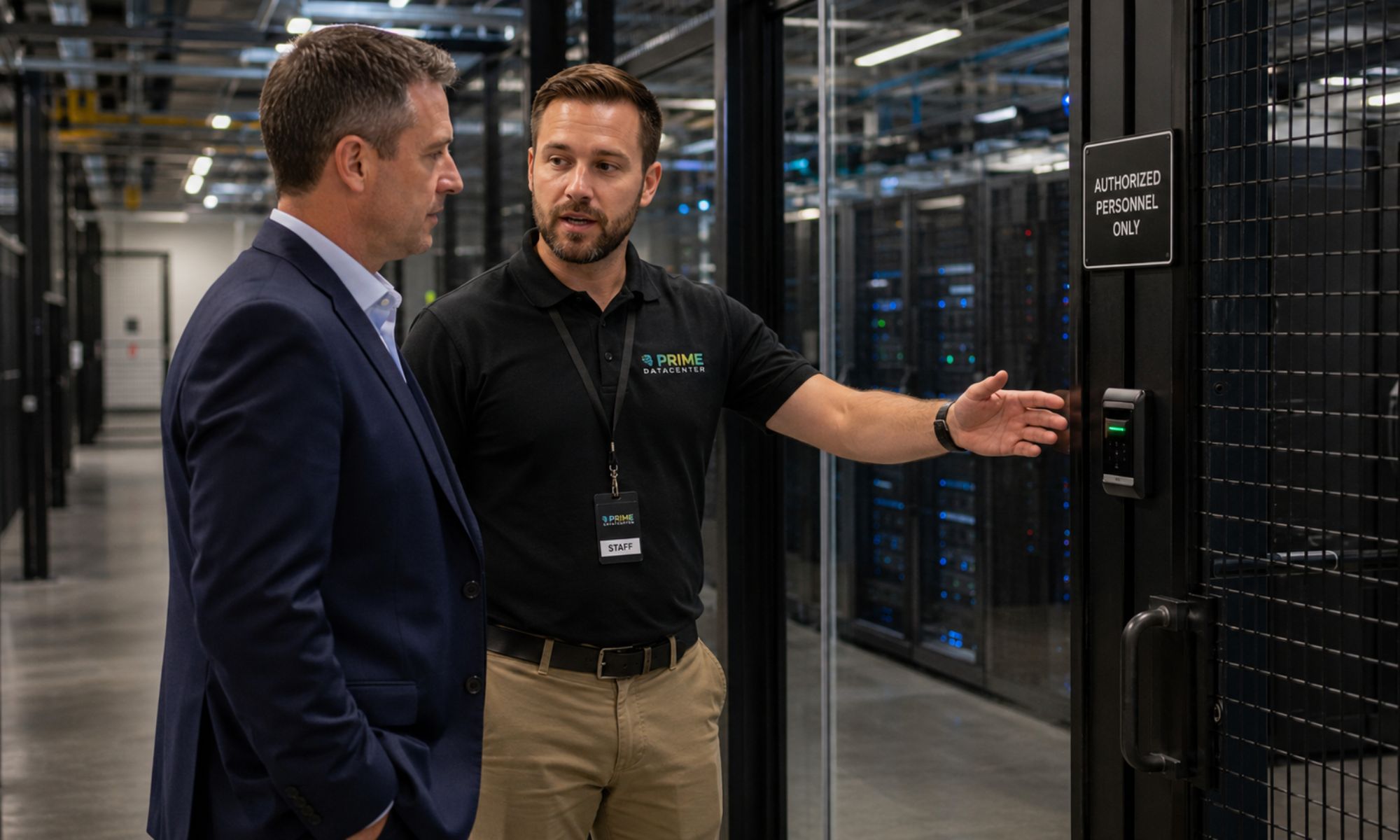
Many companies view IT security primarily from a digital perspective: firewalls, passwords, encryption, permissions and updates. These measures are important, but fall short if the underlying infrastructure is not also protected.
Servers, Storage systems, network components and firewalls require a secure operating environment. This includes controlled access, stable power supply, appropriate cooling, fire protection, structured cabling, monitoring and clear processes for maintenance and intervention.
A professional data center bundles these requirements in an environment that is designed for the long-term operation of sensitive and business-critical IT systems.
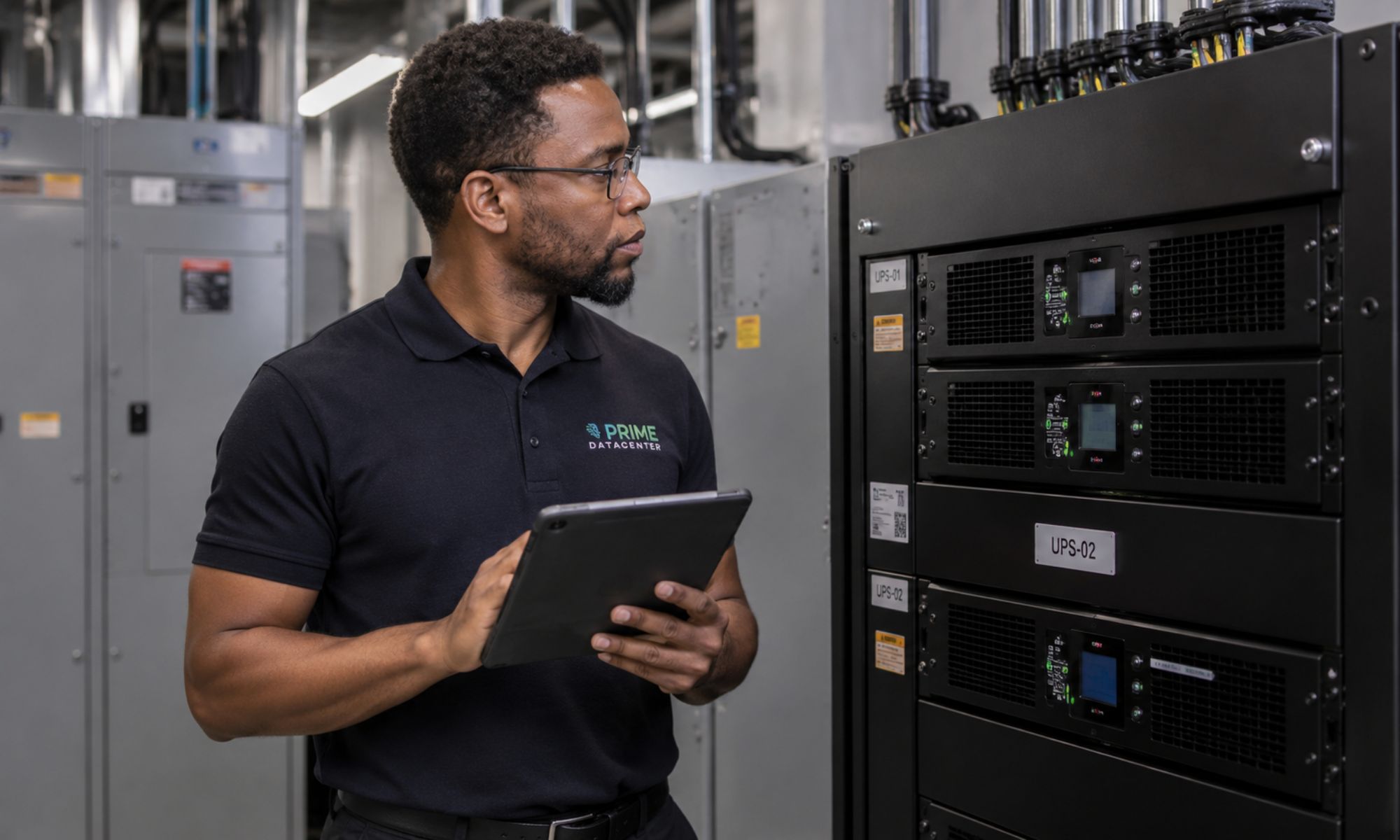
Security in the data center is based on several levels. What is crucial is the interaction between physical security, technical infrastructure, organizational control and ongoing monitoring.
Protecting the infrastructure from unauthorized entry, unauthorized access and uncontrolled interference.
Clear regulation of who has access to which areas, Racks or systems.
Stable operating conditions through power supply, cooling, Rack structure, cabling and technical redundancies.
Protection and segmentation of data traffic, secure connections and controlled network architecture.
Continuous monitoring of relevant systems in order to identify anomalies, disruptions or capacity problems at an early stage.
Documented processes for maintenance, access, escalation, troubleshooting and technical changes.
Digital security measures can only be reliable if the physical infrastructure is also protected.
Access to sensitive areas is not free, but rather according to defined authorizations and processes.
Customer-owned systems can be operated in lockable Rack environments.
A physically separate customer area can be set up for increased security requirements.
Access, maintenance work and technical interventions can be organized in a comprehensible manner.
Colocation environments can be planned so that customer infrastructures are clearly differentiated from one another.
Physical access concepts reduce the risk of third parties gaining unauthorized access to hardware or cabling.
A Private Cage provides companies with an additional layer of physical security within the data center. The customer's own infrastructure is not only operated in individual Racks, but is also housed in an exclusively separate area.
This is particularly relevant if several Racks, network components, firewalls, Storage systems or sensitive systems are to be operated together. The Private Cage creates a clear spatial separation from other customer areas and supports companies in better mapping their own security and compliance requirements.
Find out more about Private CageSecurity also means that systems operate under stable and controlled conditions.
A professional power infrastructure supports the stable operation of business-critical systems.
Suitable cooling protects hardware from overheating and supports reliable continuous operation.
Structured cabling reduces sources of error and makes maintenance, expansion and error analysis easier.
Depending on the requirements, systems, connections and components can be designed redundantly.
Monitoring relevant infrastructure assets helps to identify abnormalities at an early stage.
Planned and documented maintenance reduces risks caused by spontaneous or uncontrolled interventions.
Depending on the requirements, firewalls, separate network areas, VPN connections, dedicated connections, routing concepts and other security measures can be part of the infrastructure planning.
Separation of different network areas for better control of data traffic.
Securing applications, servers and internal services through suitable firewall structures.
Direct or separately scheduled connections for locations, cloud environments or customer platforms.
Depending on the design, protection and monitoring measures against unusual load or attacks can be taken into account.
Secure access options for administration, maintenance and external locations.
Monitoring latency, packet loss, utilization and reachability.
A data center must also be planned against risks from the surrounding area. These include fire events, temperature variations, humidity, power fluctuations and other factors.
Fire prevention, detection and response concepts are an essential part of secure data center environments.
Controlled temperature ranges help hardware operate reliably.
Suitable environmental conditions reduce risks for electronics and infrastructure.
Stable power supply supports the safe, continuous operation of sensitive systems.
Monitoring can help to detect critical changes in the environment at an early stage.
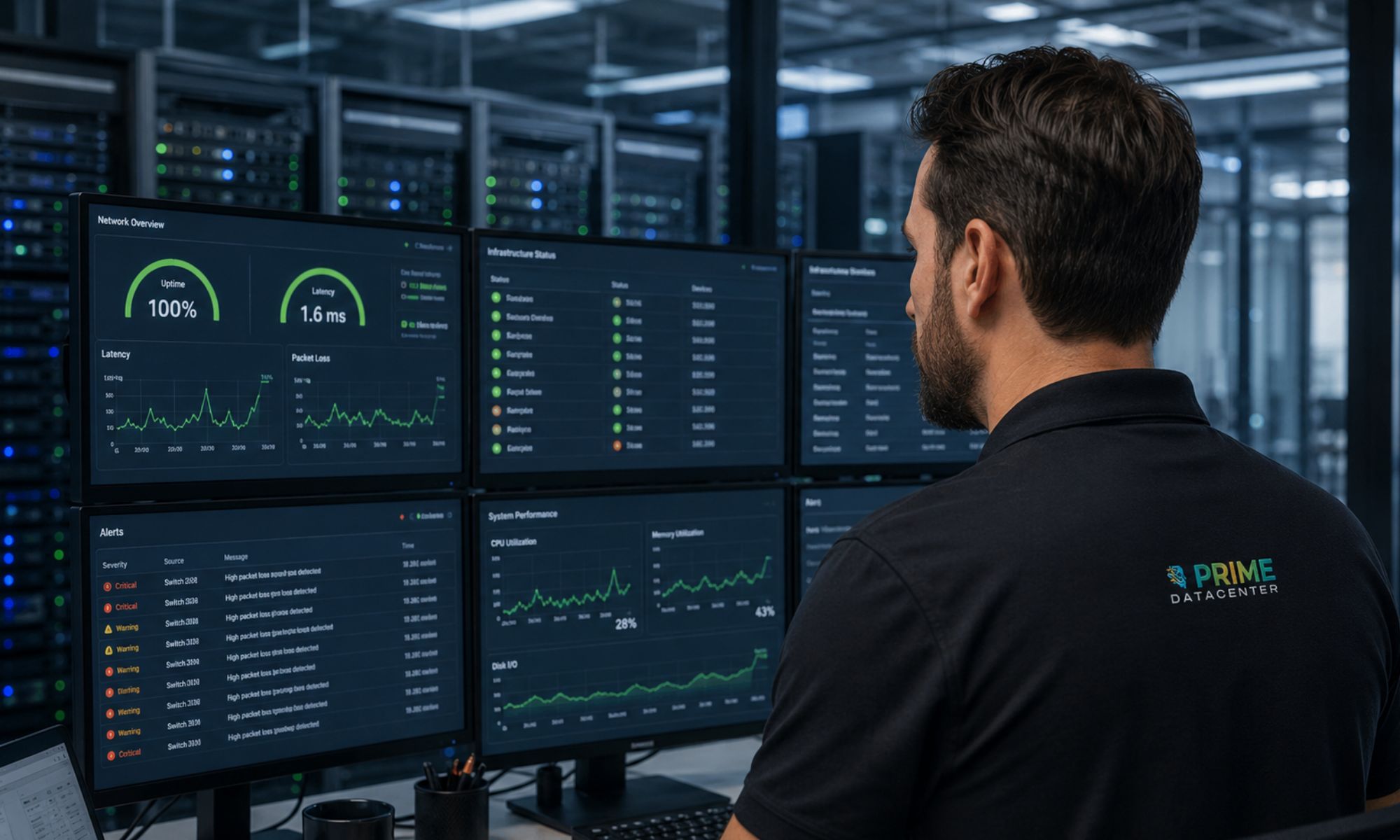
Security is not a static condition. Infrastructure must be continuously monitored so that disruptions, load peaks, unusual values or technical anomalies can be identified at an early stage.
Monitoring supports the stable operation of Colocation, hosting and cloud environments. It helps to classify problems, set priorities and react in a targeted manner.
View current system statusTechnical security is only effective if it is complemented by clear organizational processes.
Access can be regulated according to people, tasks and responsibilities.
Planned work can be prepared and communicated in a structured manner.
Technical adjustments should be documented in a comprehensible manner and implemented in a controlled manner.
In the event of an incident, clear escalation channels and communication processes help.
Comprehensible documentation supports operations, compliance and later error analysis.
Transparent information reduces uncertainty regarding maintenance or restrictions.
Depending on the initial situation, Colocation can be a safe alternative because your own hardware is operated in a professional data center environment.
Many companies still operate servers in their own technical rooms, basements, offices or improvised server rooms. These environments have often grown over time and are not consistently designed for the long-term operation of critical IT.
Colocation can be a safe alternative because proprietary hardware is still used but can be operated in a professional data center environment. Companies retain control over their systems, but benefit from better frameworks for power, cooling, physical security, monitoring and scaling.
| Area | Own server room | Colocation in the data center |
|---|---|---|
| Physical access | Often dependent on building access | Controlled access processes possible |
| Power supply | Often limited or non-redundant | Planned for IT operations |
| cooling | Often added later | Part of the operating environment |
| Fire protection | Location dependent | Considered in data center planning |
| Monitoring | Often restricted | Infrastructure monitoring possible |
| Scaling | Spatially and technically limited | Expansion more predictable |
| Responsibilities | Often distributed internally | Structured operation possible |
With Cloud Hosting and Managed Hosting, part of the responsibility shifts from the customer to the operator or service provider. Clear responsibilities, access, updates, monitoring and security measures are crucial.
For flexible resources, scalable applications and workloads that need to be operated and monitored professionally.
For companies that want to partially outsource administrative tasks, technical support or operational responsibility.
For combinations of your own hardware, cloud resources and individual security concepts.
Security also depends on which tasks remain with the customer and which services are taken over by the provider.
For many companies, it is not enough for infrastructure to be operated in a technically secure manner. Security must also be traceable, documented and explainable to internal or external requirements.
This applies, among other things, to access concepts, maintenance processes, infrastructure separation, Backup strategies, monitoring and documented responsibilities. A professional data center operation can support companies in mapping these requirements in a more structured manner.
A secure data center environment doesn't just protect hardware and data. It also improves planning, operational reliability and responsibility structure.
Professional infrastructure reduces typical weak points of improvised server rooms.
Access, responsibilities and maintenance processes can be organized more clearly.
Stable operating conditions support the long-term operation of business-critical systems.
Security concepts can grow with the infrastructure.
Companies do not have to manage all aspects of data center operations themselves.
Transparent infrastructure and security concepts make strategic IT planning easier.
Data center security includes physical security, access control, stable power supply, cooling, fire protection, network security, monitoring and organizational processes. The interaction of these levels is crucial.
Anyone who gains physical access to servers, network technology or Storage systems can potentially have a direct impact on critical infrastructure. That's why controlled access is an important part of every security concept.
Colocation can be safer if your server room is not professionally designed for power, cooling, fire protection, access and monitoring. The specific assessment depends on the existing environment and the requirements of the company.
A Private Cage provides additional physical separation within the data center. The company's own infrastructure is operated in an exclusive area that can be clearly separated from other customer areas.
Monitoring helps to detect failures, load peaks, temperature deviations, network problems or other abnormalities at an early stage. This means that problems can be classified and processed more quickly.
Yes, a professional data center environment can help to map requirements for access control, documentation, infrastructure separation, operational security and traceability in a more structured manner. Specific requirements should be examined on a project-by-project basis.
No. Security depends on architecture, configuration, operation, access concepts, updates, monitoring and clear responsibilities. Cloud and Managed Hosting can improve security if they are planned and operated professionally.
Depending on the project, requirements for physical separation, access, network, monitoring, Backup, operation and documentation can be checked individually and included in the infrastructure planning.
Would you like to operate servers, applications or customer systems in a professional data center environment? PRIME DataCenter supports you in planning a suitable infrastructure for Colocation, Private Cage, Cloud Hosting or Managed Hosting.
Together we check which security requirements are relevant for your systems and how they can be implemented in a technically, organizationally and economically sensible manner.
Request security advice Colocation offer received